Donor-funded programs are operating under different conditions than they were five years ago. Political attention has shifted and fiscal pressure is tighter. Immediate priorities often crowd out longer-term goals. None of this makes the underlying work less necessary, but it does change the conditions under which programmes gain support, maintain momentum, and deliver results.

This model reflects how Momentum thinks about donor-funded programs under those conditions. It is based on work across energy and climate initiatives in Asia, Latin America, and the Caribbean, and on patterns observed across multi-partner environments over the past fifteen years. It is not exhaustive. It captures a dynamic that tends to hold in practice across most of the programs we have been involved in or observed.

The model leads to four practical design implications, summarised at the end of this page. Readers looking for the operational takeaway can skip ahead to that section.

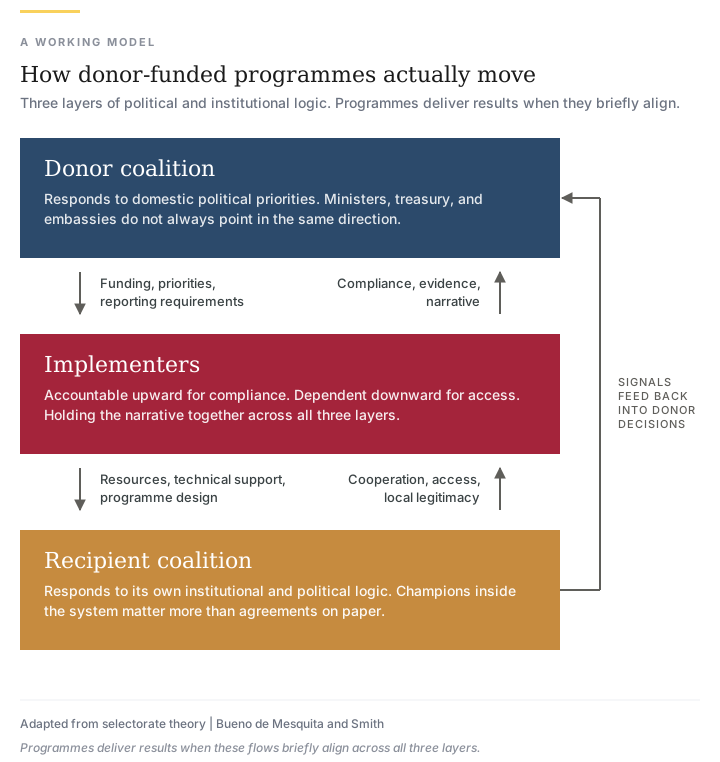
A vertical diagram of three layers of donor-funded programmes — donor coalition at the top in slate-blue, implementers in the middle in brick-red, and recipient coalition at the bottom in ochre. Between each layer, downward arrows on the left show funding, priorities, and reporting requirements flowing downward, and upward arrows on the right show compliance, evidence, narrative, cooperation, access, and local legitimacy flowing upward. A right-angle arrow on the right edge of the diagram closes a feedback loop from the recipient coalition back into the donor coalition, labelled 'signals feed back into donor decisions.'
The pattern that tends to hold

Programs tend to sustain support when they maintain coherence across all three layers: when the narrative is credible to the donor, the activities are feasible for the implementer, and the outcomes are compatible with the recipient's priorities. Impact often depends on how well it aligns with these incentives, not only on whether the technical work is sound.

What this means in practice is that program design is not only a technical exercise. It is also a political navigation exercise. The programs that tend to deliver the strongest results are the ones where the team understood what each layer needed and designed around those constraints from the start, rather than treating them as obstacles that appeared later.

When does impact become politically useful?

Impact tends to be recognised when it is visible enough for the relevant actors to point to, attributable to the parties that need to show results, timed to coincide with reporting or political cycles, and compatible with what each actor needs to justify internally.

When these conditions are met, impact is sustained and sometimes expanded or replicated.

When they are not, impact may be deprioritised even when the underlying work is genuinely valuable, because it does not fit the institutional moment.

Where real outcomes tend to happen

Most experienced practitioners can describe moments when political needs, institutional cooperation, and genuine outcomes briefly pointed in the same direction. These windows are not permanent. Recognising them, and being ready to move when they appear, is often the difference between a program that delivers on paper and one that changes something in practice.

Where programs tend to come under pressure
01
Results arrive at the wrong time. The work was solid, but the funding or reporting cycle had already closed.
02
The narratives stop fitting together. The donor needs one story, the recipient needs another, and the gap becomes too wide to bridge.
03
A key counterpart moves on. Access and momentum often follow individuals, not institutions.
04
Donor priorities shift. Programs that were well-supported find their strategic relevance reduced through no fault of their own.
05
Compliance takes over. Reporting and governance absorb so much capacity that there is limited room left to pursue the outcomes the program was designed for.
Implications for how programs are designed

These four implications follow directly from the model. They are not a checklist. They are the design moves that tend to separate programs that hold their relevance from programs that lose it.

01
Map what each layer needs early. Before the logframe, understand who needs what from this program and where those needs overlap.
02
Design so results can be clearly attributed to the actors who need them. Outcomes that nobody can point to tend to be undervalued, regardless of how real they are.
03
Know the timing. Funding cycles, elections, ministerial rotations. Align deliverables with the moments they will be used.
04
Programs that struggle to maintain a coherent narrative across stakeholders tend to become harder to sustain over time, even when the underlying work is strong.

Adapted from selectorate theory (Bueno de Mesquita & Smith, 2011) and experience inside donor-funded energy and climate programs.

Momentum works with organisations that are designing or running programmes under exactly these conditions — where political alignment is shifting and the room to manoeuvre is narrower than it was. If you are thinking through where the alignment in your programme is holding, or where it is breaking, we're available for a conversation. Send us a note.