Why programmes stall
Many energy transition programmes do not stall because the technology is wrong or the financing is absent. They stall because interacting constraints are managed sequentially rather than as a system.
Fiscal pressure diverts resources from deployment. Deployment without public engagement erodes political support. Political instability redirects fiscal resources again. These feedback loops define the actual operating environment, yet they rarely feature in how decisions are structured or how teams prepare to navigate them.
The standard response is more analysis. But the problem is not insufficient information. It is insufficient experience making resource allocation decisions where improving one variable comes at the cost of another, under scarcity and external disruption.
To make those interactions visible, we designed a decision environment that forces participants to manage four interdependent system indicators under repeated shocks and resource scarcity. The model compresses the dynamics of a multi-year transition programme into a 45–60 minute session.
The system model
The model is built around four indicators, each scored 0–10:
- Transition Strength — decarbonisation and clean energy deployment
- Energy Access — reliability and coverage of energy infrastructure
- Fiscal Space — budget stability and available funding
- Public Goodwill — social trust, political support, stakeholder buy-in
All four must reach 8 or higher by the final round. If any hits zero, the system collapses immediately.
This encodes a specific diagnostic insight: transition failure is rarely caused by one indicator collapsing alone. It is caused by the interactions between indicators being ignored. A government that pushes hard on transition strength without maintaining fiscal space runs out of funding. One that prioritises fiscal stability above all else loses public trust as progress stalls.
Every decision forces this dynamic into view. Action cards that boost one indicator often reduce another. Players must negotiate which trade-offs are acceptable given the state of the whole system, not just the indicator they are responsible for.

Resource allocation decisions within the model. Improving one system indicator requires trade-offs across others.
Encoding real operating conditions
External shocks. Each round begins with a crisis — a grid blackout, a corruption scandal, a fuel price spike. These are the normal operating environment. Players cannot prevent them. They can only decide how to absorb and respond.
Resource scarcity. The team starts with a fixed pool of resources. They cannot do everything they want. Prioritisation means accepting that some indicators will temporarily suffer.
Coordination bonuses. Improving both transition strength and energy access in the same round automatically increases public goodwill. Deploying interventions across three or more categories improves fiscal space. These bonuses reward the cross-sector coordination that is hardest to achieve under pressure.
The starting position is deliberately bleak: transition strength at 1, energy access at 3, public goodwill at 4, fiscal space at 5. Teams begin in the kind of situation that many real programmes face.
Key insight
The model is, in effect, a compact systems diagnosis. The choice of indicators, the interactions between them, the role of shocks, and the resource constraints all reflect an analysis of how energy transition programmes behave under stress. The game is the diagnosis made playable.
What the evidence showed
The model was deployed with 20 development professionals during a workshop in November 2025. 95% rated it as relevant to their professional work. The average recommendation score was 8.6 out of 10, with zero negative ratings.
The dynamics participants identified as most relevant to their own operating environments:
| Dynamic identified |
Cited by |
| Balancing competing priorities with limited resources | 55% |
| Dealing with unexpected crises and external shocks | 55% |
| Managing stakeholder expectations and public opinion | 55% |
| Coordinating across different specialist teams | 45% |
| Making decisions under fiscal and budget constraints | 40% |
What consistently broke
Several patterns appeared repeatedly. These reflect how professionals default to reasoning under systemic pressure.
Fiscal space became the binding constraint earlier than expected
Teams prioritised transition strength and energy access, assuming financing could be managed later. In most runs, fiscal space became the limiting factor by rounds three and four, forcing reactive decisions. This mirrors real programmes: fiscal sustainability is treated as a background assumption until it becomes a crisis.
Public goodwill was more fragile than anticipated
Players underestimated how quickly goodwill deteriorates under repeated shocks. Once trust declined past a threshold, recovery required disproportionate effort and often came too late. The pattern holds in real transitions: public trust is slow to build, fast to erode, and expensive to recover.
Coordination was recognised but consistently abandoned under pressure
Participants understood the value of cross-sector coordination. They discussed it openly. But under pressure, decisions reverted to siloed optimisation — each player protecting their own indicator rather than managing the system as a whole.
Short-term stabilisation crowded out long-term progress
In later rounds, teams shifted from advancing transition goals to preventing collapse. Resources that should have been invested in progress were consumed by damage control. Systems survived but did not transform. This is arguably the most common failure mode in real transition programmes: the urgent displaces the important until the window for meaningful change closes.
What this suggests
The evidence comes from a single deployment with 20 participants, but the patterns are consistent.
Most professionals do not fail to understand systems. They fail to act within them under constraint. The 95% relevance score confirms the model matched participants’ actual experience. The gap is not conceptual. It is operational.
The design of the tool encodes the diagnosis. Every mechanic reflects a specific analysis of how transition programmes behave under stress. Building the model required first diagnosing the system. That is a replicable pattern: translating systemic diagnosis into decision architecture that others can operate inside.
Low-stakes decision environments surface more honest conversation than high-stakes reviews. Trade-off decisions that might be politically sensitive in a real programme review can be explored openly when the stakes are modelled. Creating structured environments for difficult systemic conversations has value beyond any single format.
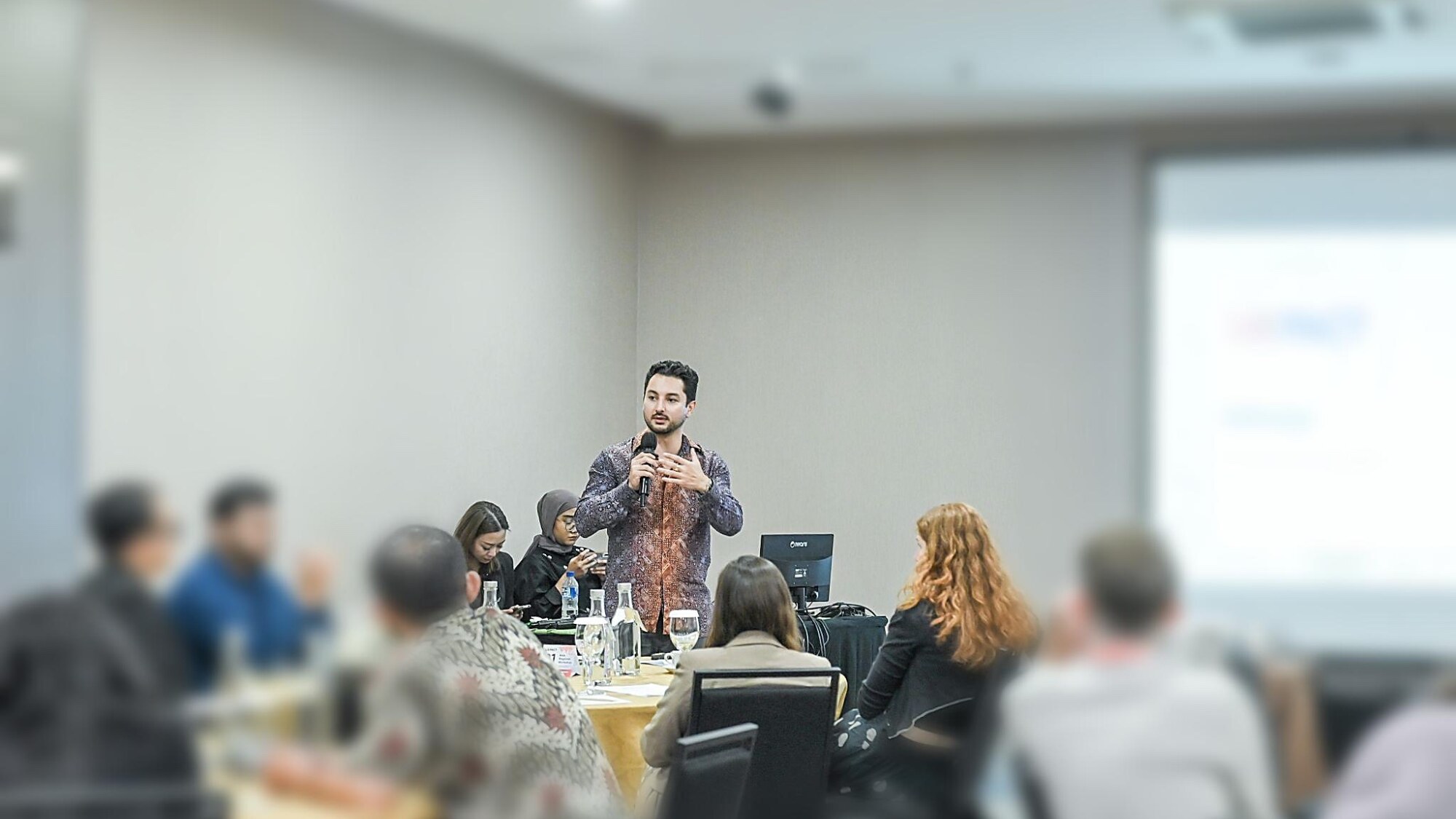
The model deployed with development professionals during the UK PACT Asia Regional Workshop, testing how teams respond to interacting constraints in energy transition systems.
Momentum Energy Advisors
Momentum works with organisations where strategy fails at the point of execution — when interacting constraints override intended plans. The starting point is not more analysis, but identifying where those interactions occur and designing interventions, decision environments, or operating structures that make them visible and manageable.
info@momentumenergyadvisors.com
← Back to Insights